If you are looking for the page with the statistics about this nation you can find it here: All Statistics
The Kingdom of Italy was one of the constituent kingdoms of the Holy Roman Empire. Modern-day Italy is covered in a different cluster.
The cluster includes the following incarnations of the same nation:
Italy (Louis II of Italy)
Italy (Berengario)
Italy (Guido of Spoleto)
Kingdom of Italy (Louis the Blind)
Kingdom of Italy (Burgundy)
Kingdom of Italy (Boso)
Kingdom of Italy (Holy Roman Empire)
Establishment
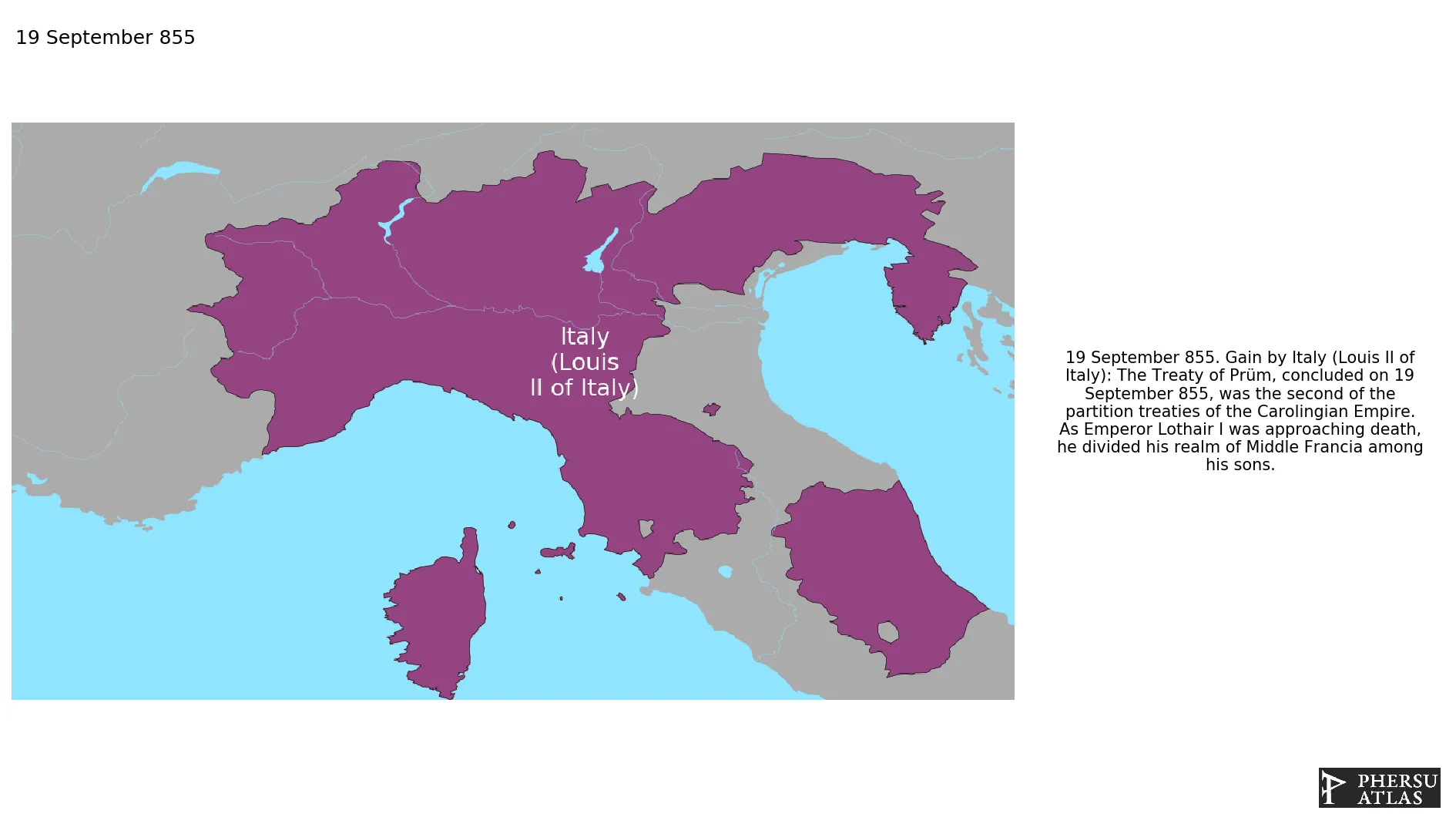
September 855: The Treaty of Prüm, concluded on 19 September 855, was the second of the partition treaties of the Carolingian Empire. As Emperor Lothair I was approaching death, he divided his realm of Middle Francia among his sons.
Chronology
Interactive Chronologies with maps are available in the section Changes Navigation
The Frankish Kingdom was partitioned and reuinited several times as the Frankish rulers used to divide their territories equally among their heirs. This lead also to a number of wars and revolts.
1.1.Partition of Middel Francia (Treaty of Prüm)
The Treaty of Prüm, concluded on 19 September 855, was the second of the partition treaties of the Carolingian Empire. As Emperor Lothair I was approaching death, he divided his realm of Middle Francia among his sons.
1.2.Partition of the Kingdom of Provence
When Frankish King Charles of Provence died, his realm was divided between his two brothers: Lothair received the bishoprics of Lyon, Vienne and Grenoble, Louis II received Arles, Aix and Embrun.
January 863: A part of lotharingia was occupied by italy.
January 863: When Charles died, his elder brother Emperor Louis II also claimed Provence, so the realm was divided between the two: Lothair received the bishoprics of Lyon, Vienne and Grenoble, to be governed by Gerard; Louis II received Arles, Aix and Embrun.
1.3.Death of Louis II of Italy
In 875, after the death of the Emperor Louis II of Italy, West Frankish King Charles the Bald, who was the uncle of Louis II, succesfully claimed the Italian crown.
December 875: In 875, after the death of the Emperor Louis II (son of his half-brother Lothair), Charles the Bald, supported by Pope John VIII, traveled to Italy, receiving the royal crown at Pavia and the imperial insignia in Rome on 29 December.
1.4.Partition of the Frankish realm after the death of Charles the Fat
After the Death of Charles the fat, Oddo was proclamated King of West francia.
January 888: In 888 Berengar of Friuli managed to convince a special diet of Counts and Bishops meeting in Pavia, then considered the capital of the Kingdom, to be elected as the successor of Charles the Fat on the Italian throne.
1.5.Invasion of Italy of Guido II of Spoleto
Independent Lombard Duke Guy III of Spoleto invaded the Kingdom of Italy.
February 889: Guido of Spoleto was victorious against Berengar, receiving the Iron Crown of Italy in Pavia on February 16, 889. However, he failed to definitively defeat Berengar, who remained in possession of the Friuli march and sought an alliance with Arnolfo.
1.6.German Invasion of Italy
Arnulf of East Francia invaded Italy.
July 894: Invoked by Berengar and by Pope Formosus, in 894 Arnolfo entered Italy and conquered Bergamo, Milan and the capital Pavia, where he made himself recognized as king of Italy, while Guido fled to his possessions. If the conquest had been easy, its maintenance was much less so: Guido was only waiting for Arnulf's withdrawal, the loyalty of the Italian vassals was changeable, and even Berengar, who had been denied the crown, appeared hostile and blocked the Brenner road. traveled on the way. Arnolfo tried to leave Italy for the Bard pass, but he found the road blocked by the forces of Anscario I, Marquis of Ivrea, helped by his enemy Rudolph of Burgundy, and only with great difficulty was he able to leave the country without major losses. Then he tried to attack Rudolph of Burgundy, who avoided fighting by retreating to the mountains. He commissioned his illegitimate son, Sventibaldo, to fight Rodolfo, but to no avail.
October 900: When Arnulph died, the imperial title was once again vacant, so the Marquis of Tuscany Adalbert and Pope Benedict IV proposed the imperial crown to Louis the Blind, King of Provence. The latter went down to Italy, defeated Berengari, had himself elected King of Italy by the Diet of Pavia (900) and had himself crowned Emperor by the Pope (901).
1.7.War in Italy between Louis the Blind and Berengar of Friuli
Was a struggle between Louis the Blind, King of Provence, and Berengar I, who was the King of Italy.
July 905: In 902 Berengar strengthened his army with mercenaries of Magyar origin and faced the new Emperor a second time, defeating him and forcing him to return to Provence. In 905 Ludovico went back to Italy, faced Berengario who defeated him a second time and imprisoned him in Verona. Ludovico, accused by the Marquis of perjury and then blinded, had to return to Provence and renounced his imperial and royal titles, leaving the Provençal kingdom in the hands of Hugh. Berengar therefore remained the only king.
1.8.Burgundian Annexion of Italy
The King of Burgundy invaded the Kingdom of Italy.
March 922: The period of peace ended in 922, when there was a conspiracy of the greats of the kingdom, including the Marquis of Ivrea, aimed at bringing the King of Burgundy Rudolph to the Italian throne. He went down to Italy, had himself elected King in Pavia and faced Berengario's army at Fiorenzuola d'Arda (or at Fidenza). Berengario was defeated (he miraculously escaped death, hidden under a shield covered with corpses) and had to acknowledge his adversary's royal title. He returned to Verona, brooding his revenge. The opportunity was offered to him when Rodolfo had to return to Burgundy to stop the designs of Duke Burcardo of Swabia on his possessions. He launched a mercenary army of 5,000 Hungarians towards Pavia, who besieged the city. Just during the siege, the launch of flaming projectiles unleashed a fire that completely destroyed the eastern part of the city (the Faramannia), including the Palazzo Regio, and part of the western one; caught between the fire and the pagans, the Pavesi paid an immense price in human lives. The fire of Pavia represented a horrible chapter in the history of those years, and from the outset the responsibility for the events was attributed to Berengario, who had unleashed the Hungarians against the population of the kingdom: for this reason some Veronesi, led by the sculdascio Flamberto, planned a plot against Berengario, who was killed in Verona in 924, pierced from behind while praying during mass.
1.9.German Annexation of italy
East Frankish King Otto I annexed the Kingdom of Italy.
December 961: Subsequently, Berengario implemented an aggressive policy towards the Papacy which prompted John XII to ask Otto to go down to Italy. In 961 the king of Germany arrived in Italy for the second time. Berengario's troops refused to fight, forcing father and son to barricade themselves at the fortress of San Leo. Otto formally deposed them from the royal title and had himself crowned Emperor by John XII.
1.10.Incoronation of Otto I
East Frankish King Otto I was crowned first Holy Roman Emperor.
February 962: Otto I, also known as Otto the Great, was the King of Germany and was crowned Emperor of the Holy Roman Empire by Pope John XII in Rome in the year 962. This event marked the beginning of the Ottonian dynasty and solidified Otto's power in the region.
The Magyars (or Hungarians) successfully conquered the Carpathian Basin (corresponding to the later Kingdom of Hungary) by the end of the ninth century, and launched a number of plundering raids thoughout Europe.
January 902: In 901, the Magyars attacked Italy again.
February 902: In 901, the Magyars attacked Italy again. The territories were left after the raid.
January 918: Between 917 and 925, the Magyars raided through Basel, Alsace, Burgundy, Provence and the Pyrenees.
February 918: Between 917 and 925, the Magyars raided through Basel, Alsace, Burgundy, Provence and the Pyrenees. The Magyars then left the raided territories.
January 922: In 921, the Hungarians raided Italy, reaching Apulia in 922.
February 922: In 921, the Hungarians raided Italy, reaching Apulia in 922. The territories were left after the raid.
January 927: In 926, the Hungarians ravaged Swabia and Alsace, campaigned through present-day Luxembourg and reached as far as the Atlantic Ocean.
February 927: In 926, the Hungarians ravaged Swabia and Alsace, campaigned through present-day Luxembourg and reached as far as the Atlantic Ocean. After the raid, the Magyars left the occupied territories.
January 928: The Hungarians marched up to Rome and imposed large tribute payments on Tuscany and Tarento.
February 928: The Hungarians marched up to Rome and imposed large tribute payments on Tuscany and Tarento. After the raid, the Hungarians left these territories.
January 936: Magyar attacks against Upper Burgundy (in 935).
February 936: Magyar attacks against Upper Burgundy (in 935). The territories were left after the raid.
January 938: In 937, the Hungarians raided France as far west as Reims, Lotharingia, Swabia, Franconia, the Duchy of Burgundy and Italy as far as Otranto in the south.
February 938: In 937, the Hungarians raided France as far west as Reims, Lotharingia, Swabia, Franconia, the Duchy of Burgundy and Italy as far as Otranto in the south. After the ride they left these territories.
January 941: In 940, the Magyars ravaged the region of Rome.
February 941: In 940, the Magyars ravaged the region of Rome. The territories were left after the raid.
January 948: In 947, Bulcsú, a Hungarian chieftain of Taksony, led a raid into Italy as far as Apulia.
February 948: In 947, Bulcsú, a Hungarian chieftain of Taksony, led a raid into Italy as far as Apulia.
August 955: The Hungarians invaded the Duchy of Bavaria in late June or early July 955.
2.1.Battle of Lechfeld
The Battle of Lechfeld was a series of military engagements over the course of three days from 10-12 August 955 in which the Kingdom of Germany, led by King Otto I the Great, annihilated the Hungarian army. With the German victory, further invasions by the Magyars into Latin Europe were ended.
September 955: The German forces of King Otto I the Great annihilated a Hungarian army (Second Battle of Lechfeld) led by harka Bulcsú and the chieftains Lél and Súr. With this German victory, further invasions by the Magyars into Latin Europe were ended.
The merger of the kingdoms of Upper and Lower Burgundy under King Rudolf II led to the establishement of the Kingdom of Arles.
January 934: After the reverses suffered by Hugh, in recent years, the Italian nobles went to Burgundy to recall King Rudolf in Italy but, having learned of it, Hugh of Arles sent his messengers to offer the King of Burgundy, Rudolf II, all the territories he had governed in Provence, on the condition that Rudolph never set foot again in Italy. Rudolf accepted and thus, in that year, the kingdom of Arles or the two Burgundies originated from the union of Transjurana Burgundy and Provence.
Expansion during the rule of Humbert I in the County of Savoy.
January 1025: In 1024, the County of Savoy, ruled by Humbert I, successfully conquered the Aosta Region.
January 1046: Conquests of Savoy until 1046.
January 1047: Savoia conquers Chieri.
Were a series of wars between the Byzantines and the Normans in southern italy and the Balkan Peninsula.
5.1.Norman conquest of southern Italy
Were a series of military campaigns by Norman forces that slowly conquered southern Italy from the Bizyntine Empire and from local Lombard rulers.
5.1.1.Conquest of the Theme of Langobardia
Were a series of military campaigns by the Normans to conquer the Byzantine Theme of Langobardia.
January 1079: The Normans conquered the Lombard county of Teate (modern Chieti). Robert I of Loritello, an Italo-Norman nobleman and the eldest son of Geoffrey of Hauteville, soon reached as far north as Pescara and the Papal States. In 1078 Robert allied with Jordan of Capua to ravage the Papal Abruzzo, but after a 1080 treaty with Pope Gregory VII they were obligated to respect Papal territory.
Expansion during the rule of Amadeus VI in the County of Savoy.
January 1357: In 1356, Ivrea passed under the dominion of the Conte Verde of Savoy.
July 926: In the same year, however, while Rodolfo was in Burgundy, northern Italy was attacked by the Hungarians, who devastated Lombardy and burned Pavia. Then Adalbert I's widow and Hugh's half-sister, Ermengarda, joined her brother, Guido of Tuscany and the archbishop of Milan, Lamperto, and they rebelled against Rodolfo. After Rudolf had definitively left Italy, the nobles who had rebelled against him, in agreement with the nobility who had supported Berengar, offered the throne to Hugh, Marquis of Provence, who accepted it and after having landed near Pisa , on 6 July 926 he was crowned in Pavia.
January 968: Foundation of the March of Monferrato by Aleramo.
January 973: San Colombano abbey ruled on Torriglia from 972 AD.
January 973: Thea area of Schwyz is acquired by the Landgraviate of Lenzburg.
January 979: Acqui was ruled by its bishop from 978.
January 980: Foundation of Bibbiena.
January 1001: Foundation of the Republic of Pisa.
January 1001: The county of Aosta was originally ruled by the bishops of Aosta in the 10th and early 11th centuries.
January 1001: Before the year 1000, Podenzana was an independent marquisate, as evidenced by the castle, rebuilt several times following various destructions.
January 1001: Around 1000, the area of Ticino ended up in the hands of the Milanese.
January 1001: Savigliano declares itself Free Commune.
January 1001: During the communal period, Como was disputed between the rival families of the Rusca (or Rusconi) and the Vitani.
January 1001: With the Ottonian imperial dynasty (second half of the 10th century) the cities of Arezzo, Chiusi, Perugia, Siena and Orvieto were enfranchised, aiming to break away from the powerful marquisate of Lucca.
January 1001: Pavia declares itself Free Commune.
January 1001: Camerino declares itself Free Commune.
January 1001: The rebirth of Modena, which became an independent commune, took place around the year one thousand.
January 1001: Around the year 1000 the city of Robbio passed to the De Robbio family, who were feudal lords.
January 1010: First mention of the Signoria of the Da Correggio family.
January 1015: In 1014 Bobbio was erected a City and Episcopal See and surrounded by city walls that form the Contea of Bobbio.
January 1021: The area of Montebibico comes under Papal rule.
January 1023: Parma became a free commune in 1022.
January 1035: Foundation of the March of Carmagnola.
January 1040: The current historiography, more cautious having to deal with an updated critical method, does not place the birth of the county of Ventimiglia beyond the 10th century. The first names of the counts of Ventimiglia appear only in 1039.
January 1051: Around 1050 Milano declares itself Free Commune.
January 1051: Start of the rule of the Fieschi family in Lavagna.
January 1051: Pisa conquers Piombino.
January 1061: The Marquisate of Gavi was an ancient Obertenga state in medieval Italy, which arose from the dismemberment of the territories that belonged to the Marca Obertenga.
January 1078: Foundation of the March of Castevoli.
January 1078: Towards the end of the 11th century, the Papacy raised the question of its sovereignty over Corsica. This claim found wide acceptance within the island itself, starting with its clergy, and in 1077 the Corsicans declared themselves subject to Rome. Pope Gregory VII (1073-1085), in the midst of the investiture controversy with the emperor Henry IV, did not directly take control of the island, but entrusted its administration to the bishop of Pisa.
January 1096: The Republic of Asti or free municipality of Asti was established in 1095.
January 1099: Albenga established itself as a commune in 1098.
January 1099: Arezzo declares itself Free Commune.
January 1099: Since 1098 Bergamo has been a free municipality.
January 1099: Donation in 1098 of Insula Fulcheria (corresponding today to the Crema area) to the city of Cremona which with this deed became a free municipality, becoming one of the richest, most powerful and most populous cities in Northern Italy.
January 1100: Foundation of the Republic of Genova.
January 1101: Establishment of Milan as an independent Commune (city-state)..
January 1101: Brescia was proclaimed autonomous municipality already in the XII century.
January 1101: Around 1100 the Del Vasto family takes control of the fief of Campo Ligure and establishes an independent city-state.
January 1101: Carrosio declares itself Free Commune.
January 1101: Matelica declares itself Free Commune.
January 1101: Montepulciano declares itself Free Commune.
January 1101: Novi declares itself Free Commune.
January 1101: Oneglia declares itself Free Commune.
January 1101: In the 10th century, the emperor Otto I granted the pro tempore bishop of Feltre, former feudal lord of the Carolingian empire, broad powers and the title of count; in the 11th century Corrado II invested him with the princely title.
January 1101: In the 12th century Ivrea became a free comune.
January 1101: Establishment of the Lecco Commune.
January 1106: The County of Masserano had an unusual political-legal status in the north-western Italian peninsula: it was, in fact, only a papal fiefdom and, to compensate for this isolation, it acquired the privilege of minting coins from an imperial source, starting with Frederick I Barbarossa.
January 1108: Prato declares itself Free Commune.
January 1108: Cremona acquired the possession of Tortona.
January 1110: Foundation of the County of Vernio by the Alberti Family of Prato.
January 1111: The Novara Commune was established in 1110 when a group of citizens drove out of the city Bishop Eppo, who was a German friend of Emperor Henry V, King of Germany.
July 1115: Upon Matilde of Canossa's death on 25 July 1115, the city of Mantova, formally an imperial fiefdom, was able to form itself into a Free Commune.
January 1116: After the death of Matilda of Tuscany in 1115, Florence became an autonomous commune, although formally still under the authority of the Holy Roman Empire.
January 1118: Pistoia declares itself Free Commune.
January 1124: Foundation of Santa Maria di Lucedio.
January 1126: Establishment of the Republic of Siena.
January 1126: In 1125, the Florentines conquered Fiesole after a siege that lasted several months.
January 1127: In the early years of the 12th century a municipal government was formed in the city of Piacenza, the genesis of which was already definitively completed in 1126.
January 1137: The first official act of the municipality of Reggio Emilia that has come down to us dates back to 1136.
January 1139: Macerata declares itself Free Commune.
January 1140: Perugia declares itself Free Commune.
January 1141: In 1140, after several decades of penetration and consolidation of the Norman presence in the region, Pescara was definitively conquered together with the rest of Abruzzo by the Norman king Roger II, being annexed to the nascent Kingdom of Sicily.
January 1142: The fiefdom of Compiano is acquired by Piacenza.
January 1143: Manfred I is documented as the first marquess of Saluzzo.
January 1143: The Marquisate of Clavesana was an ancient medieval state born from the fragmentation of the domains of Bonifacio del Vasto. The founder of the marquisate was Ugo, son of Bonifacio, who settled in the village of Clavesana and made it his capital.
January 1151: Frignanese federal municipality established in the 12th Century.
January 1151: The territory controlled by Genoa was already very large by the mid of the XII Century.
January 1151: Colle Val d'Elsa declares itself Free Commune.
January 1151: Alba declares itself Free Commune.
January 1152: Submission of Grosseto and San Giovanni d'Asso to the Republic of Siena.
January 1152: Dolceacqua declares itself Free Commune.
January 1154: Castellaro declares itself Free Commune.
January 1155: Vigevano was granted to Pavia by Holy Roman Emperor Barbarossa in 1154.
January 1155: In 1154 Gravedona was already an autonomous municipal entity, made up of a small circle of noble families.
January 1156: Siena annexes the County of Berardinghi.
August 1158: The city of Lodi was refounded on the initiative of Emperor Frederick Barbarossa on August 3, 1158, the day remembered as the date of birth of the new Lodi.
January 1161: In 1160 Cremona reconquered Crema.
January 1161: From 1160, Biella was a fief, belonging to the bishops of Vercelli.
January 1162: Foundation of the March of Incisa.
January 1163: Foundation of the Republic of Lucca.
January 1164: The municipal magistracies of San Sepolcro have been documented since 1163.
January 1164: Foundation of the March of Romagnano.
January 1165: Mulazzo was an Imperial fief that belonged to the Malaspina family since 1164 with the title of marquisate.
January 1165: In 1221 the Filattiera Marquisate was established by Obizziono Malaspina.
January 1165: In 1164 Emperor Frederick I submitted Mortara to the dominion of Pavia.
January 1165: Bagnaria declares itself Free Commune.
January 1168: The Republic od Siena conquers Civitella Marittima.
January 1169: Foundation of Alessandria and creation of a Free Commune.
January 1171: San Severino declares itself Free Commune.
January 1171: Poschiavo emerges as a distinct and independent organizational structure.
January 1171: Conquest of Castiglione di Garfagnana by the Luccans.
January 1172: Rieti Declares itself Free Commune.
January 1176: Rapolano is acquired by the Republic of Siena.
January 1178: Foundation of the Principality of Seborga.
January 1181: The imperial archchancellor trasnfers San Quirico d'Orcia to the Republic of Siena.
January 1183: In 1182 Empoli became part of the dominions of Florence.
January 1190: From 1189 to 1778 Murlo was the seat of the episcopal feud of the same name, i.e. of the ecclesiastical lordship.
January 1190: In 1189 a free republican municipality was established in Ascoli Piceno.
April 1191: Savona became a free Commune on April 10 1191.
January 1192: Foundation of the County of Poppi by the Guidi Family.
January 1193: Busalla declares itself Free Commune.
January 1194: Paganico's submission to Siena.
January 1198: Sinalunga conquered by Siena.
January 1199: In the year 1198 Cuneo established itself as a free commune.
January 1199: After various vicissitudes, which saw the borders of the Duchy of Spoleto modified and its territories separated from time to time or united with the brand of Ancona and the Romagna, in 1198 the Duchy of Spoleto became part of the Papal State.
January 1199: Foundation of the Signoria of Soragna.
January 1201: Vercelli declares itself Free Commune.
January 1201: Pesaro reverts to the control of an imperial vicar.
January 1201: The village of Pontremoli, favored by the mountainous configuration of the surrounding area, became an independent republic between the 12th and 13th centuries.
January 1201: Monza became a free municipality in the 13th century.
January 1201: Aulla declares itself Free Commune.
January 1201: Cortona declares itself Free Commune.
January 1201: Expansion of the Reggio Emilia Commune (based on maps).
January 1201: Foundation of the March of Villafranca.
January 1205: Sarzana declares itself Free Commune.
January 1209: Volterra declares itself Free Commune.
January 1211: The Republic of Siena conquers Turrita di Siena.
January 1211: At the behest of Pope Innocent III, Pesaro passed under the control of the Este family.
January 1213: Submission of Montalcino to Siena.
January 1217: Pisa conquers Massa.
September 1219: Emperor Frederick II of Swabia granted temporal power to the Bisgopric of San Giulio (Dictio Sancti Iuli).
January 1223: The former Duchy of Spoleto was briefly part of the Holy Roman Empire from 1222.
January 1229: The former Duchy of Spoleto was briefly part of the Holy Roman Empire from 1222 to 1228, when it was ceded by the Holy See.
January 1231: Conquest of Chianciano, Riadicondoli and Chiusdino by the Republic of Siena.
January 1236: Submission of the city of Pienza to Siena.
January 1237: Fossano declares itself Free Commune.
January 1237: Arnasco declares itself Free Commune.
January 1243: Crescentino declares itself Free Commune.
January 1244: Cherasco declares itself Free Commune.
January 1250: Vercelli conquers Biandrate.
January 1251: Gavorrano submitted to the Municipality of Volterra.
January 1251: Savignone declares itself Free Commune.
January 1251: The Ivrea Commune succumbed in the first decades of the following century to the rule of Emperor Frederick II.
January 1256: The Republic of Lucca establishes the city of Pietrasanta in the place of an old Lombard fortress.
January 1256: The city of Trequanda is annexed by the Republic of Siena.
January 1258: The Piacenza Landi family ruled these territories from 1257.
January 1265: Giglio Island was added to the possessions of Pisa in 1264.
January 1266: In 1265, upon the death of the marquis Bernabò Malaspina, the fief of Olivola was erected into a marquisate.
January 1271: Poggiobonizio was a Ghibelline city, proclaimed an 'imperial city' by Frederick II of Swabia in 1220. In 1270, it was conquered by the Florentine armies with the support of Neapolitan troops. After the conquest, the city assumed the modern name of Poggibonsi.
January 1276: The Cacciaconti-Scialenga family of Siena buys the city of Asciano.
January 1283: The Republic of Siena purchased Campagnatico from the Viscounts of Campiglia.
January 1291: With the decline of the Swabians' control over San Miniato, it took sides in the Guelph camp, taking part in the political events of the time, finally being able to organize itself as a "free commune".
January 1294: The Republic of Siena acquired corralbegna from the Ranieri counts.
January 1301: Expansion of the Florentine state throughout the entire area surrounding Florence.
January 1301: At the end of the thirteenth century, the Marquises del Bosco were definitively removed by arms from Masone which, from that moment, became a fief of the Genoese Republic.
January 1301: The Republic of Lucca acquires the area of Montignoso.
September 1303: In May 1303, the abbot of the monastery of San Salvatore, Fra Ranieri, arrived in Siena proposing to the government of the Nine the purchase of the land owned by the monastery (even though at the time they were however militarily occupied by the Counts of Santa Fiora) including Talamone and Castiglion di Val d'Orcia.
January 1308: Giberto III da Correggio 1307-1321 lord of Guastalla.
January 1312: Foundation of the Duchy of Mirandola by Francesco I Pico.
January 1314: The Signoria of Carrara was a feud in northern Tuscany, which existed from the beginning of the 14th century.
January 1320: Foundation of the Signoria of Carpi.
January 1336: In 1335, the Republic of Siena annexed the territories of Massa Marittima, Monterotondo, and Gavorrano.
January 1341: Foundation of the March of Fosdinovo by Galeotto I Malaspina.
January 1341: In the Middle Ages, therefore, its history was identified with that of the Verrucola castle, enlarged in the first half of the 14th century by the famous feudal lord Spinetta Malaspina known as Il Grande and located on the hill adjacent to the town.
January 1342: In 1341 Barga submitted to Florence.
January 1352: Under the control of the Malaspina marquises, Bagnone became an independent fiefdom in 1351.
May 1371: Foundation of the County of Novellara by Feltrino Gonzaga.
January 1378: The Florentine state conquers various territories in central and northern Tuscany up to 1377.
January 1391: The counts of Battifolle sell Cinigiano to the Republic of Siena.
January 1395: The Pallavicino State was established in 1394 with Roland I the Magnificent Pallavicino.
January 1395: Fieschi conquers Crevacuore and Masserano.
January 1408: In the period from 1407 to 1416 the feud of Rocchetta-Suvero was administered by Gabriele Malaspina.
January 1411: Albiano was dominated by the Malaspina, from whom the people of Albiano emancipated themselves to entrust themselves to the Republic of Florence as early as the fifteenth century. The Florentine Signoria sent its Commissioner there in 1410.
January 1417: Foundation of the March of Sorbello.
January 1430: The cities of Garfagnana made an act of dedication to the Este family in 1429.
January 1442: In 1441, the inhabitants of Massa entrusted themselves to the Marquis of Fosdinovo Antonio Alberico I Malaspina.
January 1502: Foundation of the Signoria of San Martinoin Rio by Sigismondo d'Este.
Disestablishment
January 1686: In 1685 Montemarzino was granted to the Spanish branch of the Spinolas, marquises of los Balbases.
Selected Sources
Archivio storico italiano (1905), Volume XXXV, Florence (Italy), p. 212
Bini, M. (2005): Firenze, l'occhio e la mano: esperienze di lettura e interpretazione grafica dell'ambiente urbano fiorentino, Florence (Italy), 2005, p. 18
Davidsohn, R. (1909): Storia di Firenze: le origini, Volume 2, Florence (Italy), p. 878
Droysen, G. (1886): Historischer Handatlas, Bielefeld and Leipzig (Germany)
La via del Diaspro rosso di Barga. Retrieved July, 17th, 2021, from https://www.visitbarga.com/escursioni/la-via-del-diaspro-rosso-di-barga/
Lajos G. (2011): Hungary in the Carpathian Basin, Budapest (Hungary), p. 18
Leyser, K. (1982): Medieval Germany and its neighbours, 900-1250, London (UK), p. 50
Makkai, L. (1990): The Hungarians' prehistory, their conquest of Hungary and their raids to the west to 955, in: A History of Hungary, Bloomington (USA) p. 8-14
Poole, R.L. (1902), Historical Atlas of Modern Europe, Oxford (United Kingdom), Plate LXVIII
Poole, R.L. (1902): Historical Atlas of Modern Europe, Oxford (United Kingdom), Plate LXVIII
Pratelli, F. (1990), Storia di Poggibonsi, Poggibonsi (Italy), pp. 173-199
Repetti, E. (1833), Dizionario geografico, fisico, storico della Toscana: contenente la descrizione di tutti i luoghi del granducato, ducato di Lucca, Garfagnana e Lunigiana, Volume 1, Florence (Italy), p. 63
Repetti, E. (1845), Supplemento al Dizionario geografico, fisico, storico della Toscana, Florence (Italy), p. 9
Reuter, T. (1995): The New Cambridge Medieval History: c. 900-c. 1024, Cambridge (UK), p. 543
Reuter, T. (1995): The New Cambridge Medieval History: c. 900-c. 1024, Cambridge University Press, p. 543
Sugar, P. F. / Hanák, P. (1994): A History of Hungary, Bloomington (USA), p. 13
Timothy R. (1995) The New Cambridge Medieval History Volume 3, c. 900-c. 1024, Cambridge (UK), p. 543

.svg.png.webp)
.png.webp)
 italy (frankish)


