ebla
ebla
If you are looking for the page with the statistics about this nation you can find it here: All Statistics
The cluster includes all the forms of the country.
The cluster includes the following incarnations of the same nation:
First Eblaite Kingdom
Second Eblaite Kingdom
Third Eblaite Kingdom
Third Eblaite Kingdom (Yamhad)
Establishment
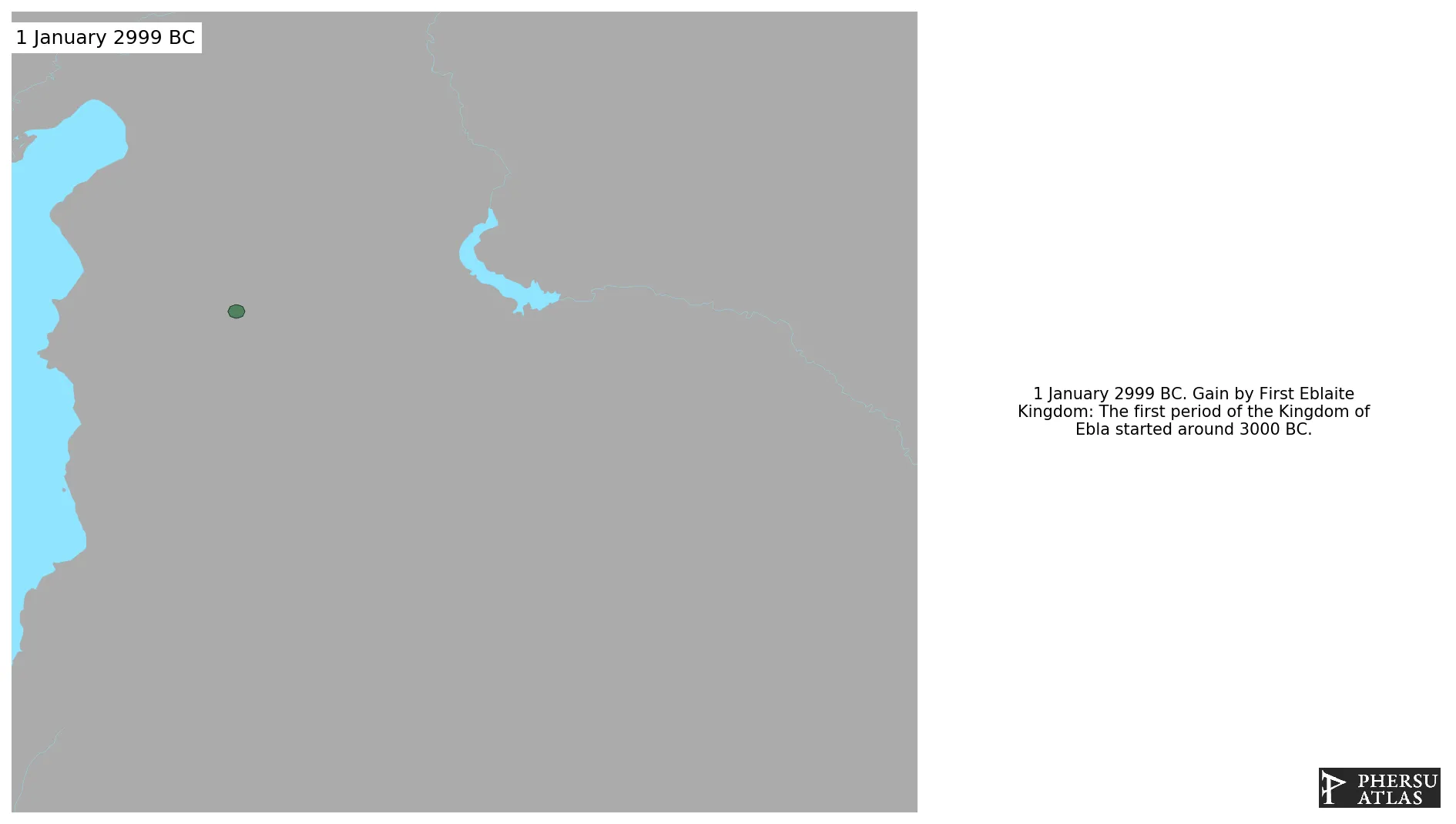
January 2999 BC: The first period of the Kingdom of Ebla started around 3000 BC.
Chronology
Interactive Chronologies with maps are available in the section Changes Navigation
Was the military compaign against Ur of Lugal-Anne-Mundu, king of the city-state of Adab in Sumer.
January 2499 BC: Lugal-Anne-Mundu (king of the city-state of Adab in Sumer) subjugated the "Four Quarters of the world" (the entire Fertile Crescent region, from the Mediterranean to the Zagros Mountains). His empire is said to have included the provinces of Elam, Marhashi, Gutium, Subartu, the "Cedar Mountain land" (Lebanon), Amurru or Martu, "Sutium" and the "Mountain of E-anna".
January 2459 BC: Following the death of Adab King Lugal-Anne-Mundu, his Empire collapsed and most of the subjected cities regained their independence.
Military campaigns of Mariote king Zim-ri-Lim.
January 1769 BC: Conquests of Mariote King Zim-ri-Lim.
January 2449 BC: In the mid-25th century BC, Eblaite King Kun-Damu defeated Mari and expanded the territory of his Kingdom.
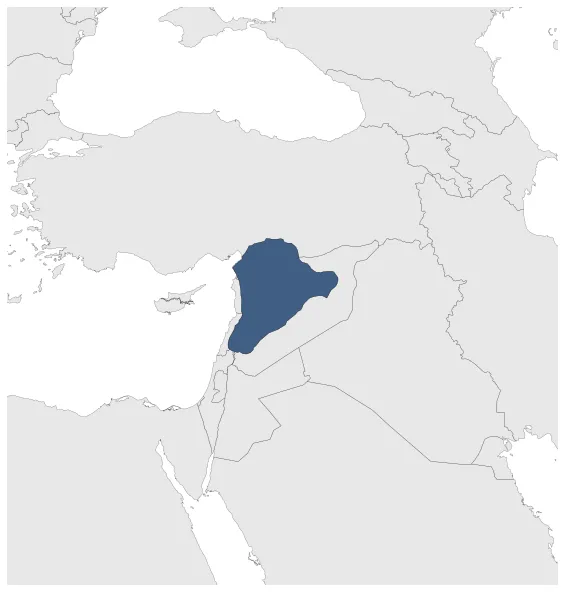
January 2339 BC: The first Eblaite Kingdom at ist heigth (c. 2340 BC) extended from Urshu in the north, to Damascus area in the south. And from Phoenicia and the coastal mountains in the west, to Tuttul, and Haddu in the east.
January 2299 BC: First destruction of the Eblaite Kingdom (c. 2300 BC). The palace of Ebla was burned. The exact circumstances and the perpetrators of the destruction are unknown.
January 2217 BC: The Akkadians under Sargon of Akkad and his descendant Naram-Sin invaded the northern borders of Ebla.
January 1999 BC: In the Middle and Late Bronze Age, Nuḫašše referred to a region in the north of present-day Syria east of the Orontes. The area does not appear to have been a unified kingdom but rather a federation of various small principalities.
January 1999 BC: The Kingdom of Qatna was established around 2000 BC.
January 1999 BC: Amurru was an Amorite kingdom established c. 2000 BC, in a region spanning present-day western and north-western Syria and northern Lebanon.
January 1999 BC: The second kingdom of Ebla disintegrated toward the end of the 21st century BC, and ended with the destruction of the city by fire. The reason for the destruction is not known.
January 1999 BC: Kizzuwatna was an ancient Anatolian kingdom that existed since the 2nd millennium BC. It was situated in the highlands of southeastern Anatolia, on the trade route between Assysria and the city of Kanesh.
January 1809 BC: Yamhad, an ancient Semitic kingdom centered on Ḥalab (today Aleppo, Syria), emerged at the end of the 19th century BC.
January 1799 BC: By the beginning of the 18th century BC, Ebla had become a vassal of Yamhad, an Amorite kingdom centered in Aleppo.
Disestablishment
January 1769 BC: Conquests of Mariote King Zim-ri-Lim.
Selected Sources
Al-Maqdissi, Michel (2010). "Matériel pour l'Étude de la Ville en Syrie (Deuxième Partie): Urban Planning in Syria during the SUR (Second Urban Revolution) (Mid-third Millennium BC)". Al-Rāfidān (Journal of Western Asiatic Studies). Special Issue. Institulte for Cultural studies of Ancient Iraq, Kokushikan University. ISSN 0285-4406. p. 140
Astour, Michael C. (1992). "An outline of the history of Ebla (part 1)". In Gordon, Cyrus Herzl; Rendsburg, Gary (eds.). Eblaitica: Essays on the Ebla Archives and Eblaite Language. Vol. 3. Eisenbrauns. ISBN 978-0-931464-77-5. p. 19
Astour, Michael C. (2002). "A Reconstruction of the History of Ebla (Part 2)". In Gordon, Cyrus Herzl; Rendsburg, Gary (eds.). Eblaitica: Essays on the Ebla Archives and Eblaite Language. Vol. 4. Eisenbrauns. ISBN 978-1-57506-060-6. p. 101
Astour, Michael C. (2002). "A Reconstruction of the History of Ebla (Part 2)". In Gordon, Cyrus Herzl; Rendsburg, Gary (eds.). Eblaitica: Essays on the Ebla Archives and Eblaite Language. Vol. 4. Eisenbrauns. ISBN 978-1-57506-060-6. p. 79
Barca, N. (2023), Knossos, Mycenae, Troy: The Enchanting Bronze Age and its Tumultuous Climax, Oxbow Books, p. 219
Cyrus Herzl Gordon, Gary Rendsburg, Nathan H. Winter (1987): Eblaitica: Essays on the Ebla Archives and Eblaite Language, Eisenbrauns, pp. 101-107
Diane Bolger, Louise C. Maguire (2010): The Development of Pre-State Communities in the Ancient Near East: Studies in Honour of Edgar Peltenburg, Oxbow Books, Cap. 11
Dolce, Rita (2008). "Ebla before the Achievement of Palace G Culture: An Evaluation of the Early Syrian Archaic Period". In Kühne, Hartmut; Czichon, Rainer Maria; Kreppner, Florian Janoscha (eds.). Proceedings of the 4th International Congress of the Archaeology of the Ancient Near East, 29 March - 3 April 2004, Freie Universität Berlin. Vol. 2. Otto Harrassowitz Verlag. ISBN 978-3-447-05757-8. p. 68
Dolce, Rita (2010). "Ebla and its origins – a proposal". In Matthiae, Paolo; Pinnock, Frances; Nigro, Lorenzo; Marchetti, Nicolò; Romano, Licia (eds.). Proceedings of the 6th International Congress of the Archaeology of the Ancient Near East: Near Eastern archaeology in the past, present and future: heritage and identity, ethnoarchaeological and interdisciplinary approach, results and perspectives; visual expression and craft production in the definition of social relations and status. Vol. 1. Otto Harrassowitz Verlag. ISBN 978-3-447-06175-9. p. 252.
Douglas Frayne (1 January 1990). Old Babylonian Period (2003-1595 BC). University of Toronto Press. p. 780
Feldman, Marian H. (2007). "Frescoes, exotica, and the reinvention of the northern Levantine kingdoms during the second millennium b.c.e.". In Heinz, Marlies; Feldman, Marian H. (eds.). Representations of Political Power: Case histories from times of change and dissolving order in the ancient Near East. Eisenbrauns. ISBN 978-1-57506-135-1. p. 55
Gordon Douglas Young (1981): Ugarit in Retrospect: Fifty Years of Ugarit and Ugaritic, Eisenbrauns, p.4
Jonathan N. Tubb (1998): Canaanites, University of Oklahoma Press, p. 39
Maria Eugenia Aubet (2001): The Phoenicians and the West: Politics, Colonies and Trade, Cambridge University Press, p. 18
Matthiae, Paolo (2013a). "A Long Journey. Fifty Years of Research on the Bronze Age at Tell Mardikh/Ebla". In Matthiae, Paolo; Marchetti, Nicolò (eds.). Ebla and its Landscape: Early State Formation in the Ancient Near East. Left Coast Press. ISBN 978-1-61132-228-6. p. 37
Matthiae, Paolo (2013a). "A Long Journey. Fifty Years of Research on the Bronze Age at Tell Mardikh/Ebla". In Matthiae, Paolo; Marchetti, Nicolò (eds.). Ebla and its Landscape: Early State Formation in the Ancient Near East. Left Coast Press. ISBN 978-1-61132-228-6. p. 38
New York Times Encyclopedic Almanac, New York Times, Book & Educational Division., 1970, p. 564
Padovese, L. (2009): Paolo di Tarso: Archeologia - Storia - Ricezione, Effata Editrice IT, p.6
RIME 1.01.08.01 composite (P450160). Cuneiform Digital Library Initiative. Retrieved on 29 March 2024 on https://cdli.mpiwg-berlin.mpg.de/search?layout=full&id=P450160
Singer, I. (1991). "The "Land of Amurru" and the "Lands of Amurru" in the Šaušgamuwa Treaty". Iraq. 53: 69–74. doi:10.2307/4200336. JSTOR 4200336. S2CID 131582702.
Thuesen, Ingolf (2000). "The City-State in Ancient Western Syria". In Hansen, Mogens Herman (ed.). A Comparative Study of Thirty City-state Cultures: An investigation. Vol. 21. Kgl. Danske Videnskabernes Selskab. ISBN 978-87-7876-177-4. p. 61
Torrecilla, E. (2022). 2022 - Reflections on the Qaṭna Letters TT1-5 (I): Hittite Expansionism and the Syrian Kingdoms. Aula Orientalis 40.